

The image of someone slowly savoring a 7,000 KRW latte inside a traditional hanok cafe, contrasted with another person hurrying to work with a 1,500 KRW Americano in hand, is not merely a matter of income disparity. It is a portrait of how Korean society allocates two distinct types of time: time for staying and time for moving.
With a market size of approximately 15 trillion KRW (around $11 billion), Korea’s coffee industry does not simply signal caffeine addiction. Rather, it reflects a structural pattern: through coffee, people are purchasing space and efficiency.
1. A 15 Trillion KRW Market: Beyond Preference, Toward Survival Fuel ☕
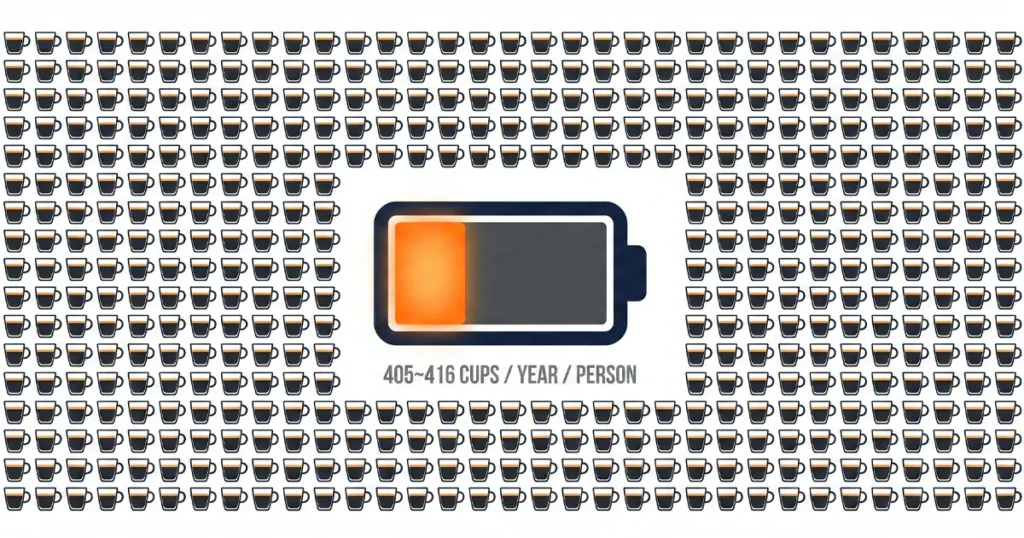
As of 2023, Korean adults consume approximately 405–416 cups of coffee per person annually—more than double the global average of roughly 150 cups. This figure cannot be explained as an expansion of taste alone.
Korea remains among the upper ranks of OECD countries in working hours. It is a high-density society where homes are compact, workplaces operate at high speed, and securing a fully separate personal space is not always easy. Within these conditions, cafes function as a buffer zone between private and public life.
Coffee has become more than a beverage. It is fuel that sustains productivity and, at the same time, a socially acceptable mechanism to justify a pause. The 15 trillion KRW market should not be read as excessive discretionary spending; rather, it represents the expansion of an alternative infrastructure shaped by accumulated social fatigue.
2. Premium Strategy: Selling Spatial Power and Narrative 🏙️
As of late last year, Korea recorded 2,009 Starbucks stores, ranking third globally after the United States and China. Even when measured by stores per million residents, Korea maintains one of the highest densities in the world. Since its first store opened in 1999, Starbucks Korea has surpassed 3 trillion KRW in annual revenue within 25 years.
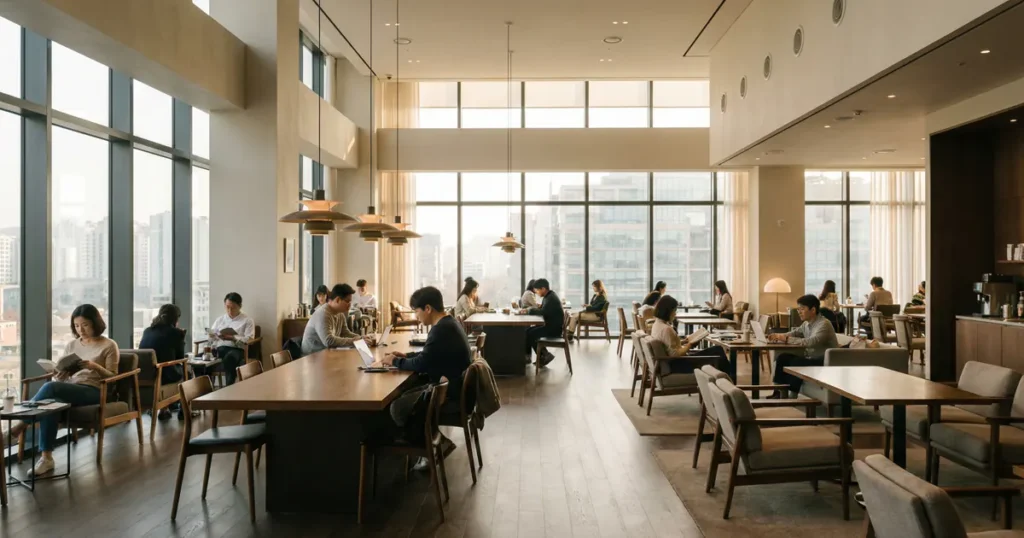
This growth was not built solely on coffee quality. Korean consumers are paying for the experience of staying.
Occupying Staying Time Through Space Marketing
Starbucks does not merely sell beverages; it proposes a “Third Place.” Certain locations—such as the Aegibong Peace Ecopark branch in Gimpo—have become destinations in themselves, demonstrating how space can be narrativized.
The price of a 7,000 KRW latte includes more than milk and espresso. It includes an environment that is more comfortable than home and freer than the office. This is not simply pricing strategy; it is a method of occupying staying time.
In a society where personal living rooms are often limited and workplaces are highly structured, premium cafes partially compensate for the lack of a personal third space. They extend dwell time and monetize spatial comfort.
3. Yellow Brands and the Seizure of Moving Time 🟡
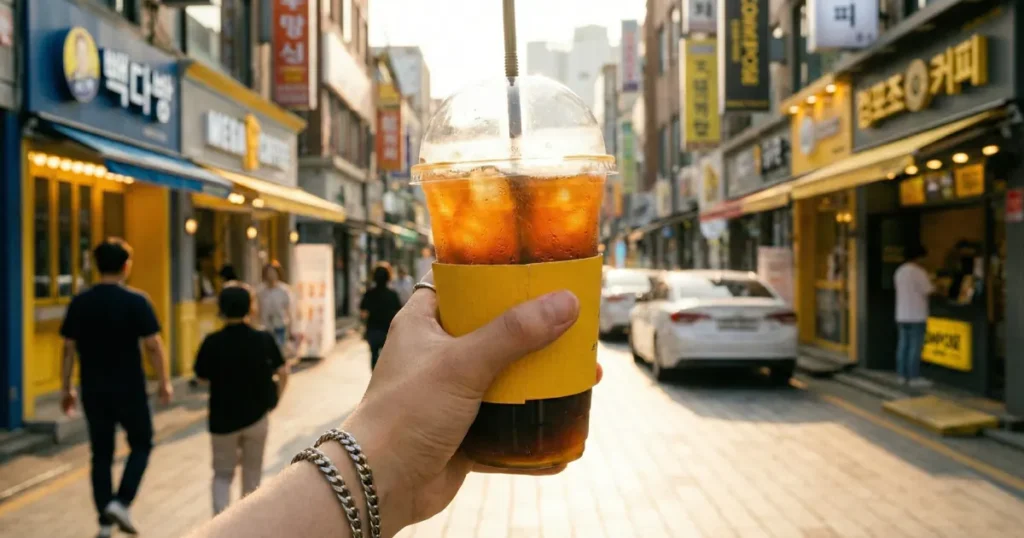
On the opposite end of the spectrum, low-cost brands have expanded at remarkable speed, filling urban landscapes with dense clusters of yellow signage.
Mega Coffee has surpassed 3,500 stores. Compose Coffee has exceeded 2,800 locations and is rapidly approaching the 3,000 mark. Paik’s Coffee has also joined the expansion race. Together, these brands have constructed a highly concentrated low-cost network.
What they capture is not leisure—it is fragments of motion: three minutes during a commute, seven minutes after lunch.
Designing for Efficiency and Flow
The ability to maintain a 1,500 KRW price point relies on a high-rotation model. Compact storefronts of roughly 30 square meters (around 300 square feet), takeout-focused layouts, and streamlined preparation systems are engineered around customer movement paths.
Rather than emphasizing staying value, these brands optimize moving time. They integrate seamlessly into daily routines, occupying transitional moments between destinations.
In doing so, yellow brands have established the second axis of the 15 trillion KRW market: efficiency.
🏁 Conclusion: $5 Space and $1 Efficiency in the Same City
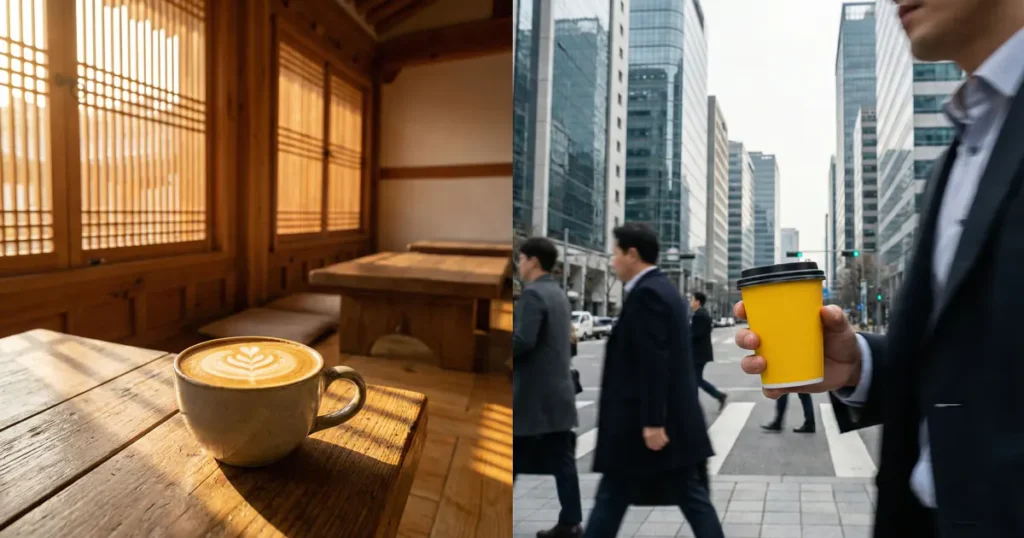
Ultimately, the core of Korea’s coffee industry lies not in taste competition but in time allocation structures.
Premium brands expand staying time. Low-cost brands compress moving time.
Coffee functions simultaneously as labor fuel, as a device that legitimizes rest, and as a subtle marker of belonging within everyday urban life. As long as the boundary between home and work remains blurred, $5 space and $1 efficiency will continue to grow side by side within the same city.
The Korean coffee market is enormous not because people simply enjoy coffee, but because within it, they can momentarily reclaim time.